
$5.99 for Our Blood: The Gamification of Black Death
By Izetta Henderson
27 October 2026
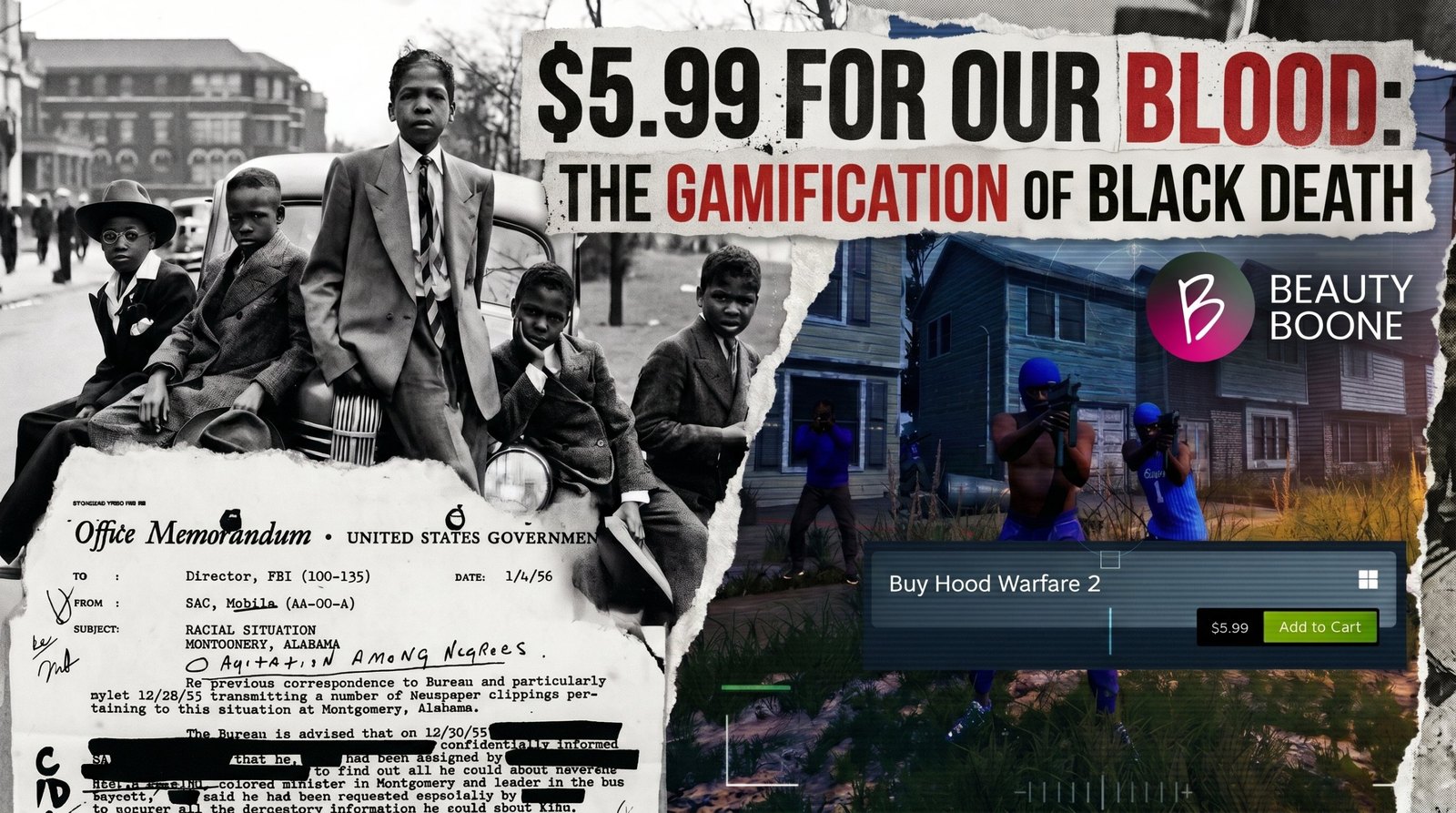
At what point did real world violence and generational disinvestment become an interactive, six-dollar playground?
That is the naked reality behind Hood Warfare 2, a $6 shooter built in Unreal Engine 5 and hawked as a satirical, Chicago-style Call of Duty. Slapping the word "satire" on a store page doesn't change the mechanics: it turns Black neighborhoods into open-air shooting galleries, Black bodies into target practice, and real-world trauma into an in-game reward loop.
Look at what is actually being gamified. Game modes titled "GangBang," "Hit A Lick," and "Chain Snatch." Maps named "The Trenches." Killstreaks that trigger drive-by shootings with switch Glocks. This isn't edgy subversion. It is an interactive minstrel show engineered for digital consumption.
Don't dismiss this critique as fragility. Interrogating who benefits from Black bloodshed has always been a matter of survival.
Through COINTELPRO, the FBI systematically infiltrated Black organizations, deliberately stoking factional warfare and bloodshed between groups like the Black Panther Party and US Organization. Weaponizing internal division was never a fringe conspiracy; it was documented state policy.
Does that mean the state built this game? We don’t have definitive proof today. But anyone familiar with history knows better than to call it an impossibility. Steam lists the developer and publisher as "Trapstar Games." But that makes the foundational questions even more urgent: Who owns this entity? Who funded it? Who cashes the checks every time someone pays $6 to simulate an execution on the South Side?
Who decided Black death was an untapped budget gaming demographic?
This is where the desensitization pipeline does its work. We are living through an era where state violence and digital play have fully merged. Video game interfaces mirror the remote targeting displays used to surveil, displace, and slaughter civilians from Gaza to the wider global theater, reducing human beings to data points and collateral damage.
When you port that exact visual framework into urban America, the message is unmistakable: Black lives are disposable, ambient enemies in a perpetual war zone.
"Black-on-black crime" has always been a weaponized myth used to obscure the structural violence of segregation, redlining, state disinvestment, and militarized policing. But games like this strip away every ounce of systemic reality, leaving behind a sick playground where Black existence is reduced to reflexive slaughter.
Make no mistake: the dehumanization packaged in that software doesn’t stay in the game. It bleeds directly into the workplace and follows us in job interviews, performance reviews, the doctor's office, the banks, and the places that we shop. So, this is not a plea for censorship. It is an indictment of complicity.
Every piece of media makes an ideological choice about who gets to be human and who exists merely to be killed. When Black communities are systematically erased as places of labor, family, and resistance, and reduced strictly to kill zones, it trains an entire generation of players to see Black pain as background noise.
Stop letting our neighborhoods serve as content farms for digital parasites.
If developers want to monetize our geography, demand radical transparency: show who owns the studio, who backed the budget, and who profits from the body count. Stop giving exploitative garbage free viral marketing under the guise of "hate-playing."
Most importantly, redirect the capital. Starve the digital vultures and bankroll Black developers, writers, and artists who build worlds defined by agency, dignity, and life rather than disposable corpses.
The question isn't whether games influence reality. The question is much simpler: Who is getting rich off the spectacle of our destruction and why are we still paying admission?
We cannot afford to leave that question hanging in the air while the next studio calculates the profit margin on our grief. Awareness without leverage changes nothing. If our lives are worth more than a six-dollar download, our collective response, from community organizers to entrepreneurs, must be swift, structural, and sustained:
Community Action Plan: Beyond Consumption
1. Demand Platform & Publisher Transparency
- Hold distribution hubs accountable: Digital storefronts like Steam, Epic Games, and PlayStation Store enforce community standards around hate speech and exploitation, yet host titles trading on racialized slaughter. Organize community reporting campaigns demanding ownership disclosure and clear enforcement on titles that monetize racial caricatures.
- Track the capital: Push for digital media literacy programs that teach consumers how to trace parent companies, publisher footprints, and venture funding behind viral media before handing over attention or dollars.
2. Starve the Outrage Machine (Kill the Algorithm)
- Halt the hate-streaming: Content creators thrive on rage clicks and reaction streams. Boycott and unfollow streamers or influencers playing exploitative titles under the guise of "satire" or ironic play.
- Deny them organic reach: Critique without linking directly to purchase portals, taglines, or sales hubs. Refuse to be unpaid marketing for platforms built on our degradation.
3. Build and Fund Our Own Tech Ecosystems
- Redirect capital to Black game studios: Actively back developers creating independent games centered on Black imagination, world-building, and agency (e.g., initiatives and studios highlighted by organizations like Game Devs of Color Expo and Black in Gaming).
- Fund local creative labs: Invest in neighborhood coding bootcamps, Unreal Engine/Unity workshops, and game-design incubators for youth. When our children hold the tools to build worlds, they stop being cast as disposable assets in someone else’s.
4. Organize Cultural Advisory & Accountability Boards
- Pressure gaming industry bodies: Call on gaming coalitions and developer unions to institute review standards that distinguish genuine political satire from bad-faith digital minstrelsy.
- Protect our real-world geography: Support neighborhood coalitions, violence-prevention workers, and community centers working on the ground in cities like Chicago. Remind the culture that real people live, organize, and build where these digital shooters drop their killstreaks.
Directives for Business Owners, Founders, and Entrepreneurs
- Refuse Complicity in Ad Spend and Placement: Audit automated programmatic advertising and promotional pipelines. Ensure marketing dollars do not run alongside, sponsor, or monetize content creators, streams, or media networks that exploit racialized violence for viral traffic.
- Seed and Angel-Fund Independent Creators: Capital is the primary barrier for independent Black technologists, game designers, and digital storytellers. Venture capitalists, angel networks, and established business owners can actively create syndicate funds and grant pools to finance Black-led studios with non-extractive capital.
- Build Proprietary Pipelines for Local Talent: Fund and partner with grassroots digital-arts academies, game-development cohorts, and tech apprenticeships in disinvested neighborhoods. Supplying hardware, software licenses, and direct mentorship equips young creators with the tools to own their intellectual property and dictate their own narratives.
- Establish Cross-Industry Ethical Standards: Form coalitions across tech, retail, and marketing that set clear boundaries against monetizing cultural trauma. Use corporate leverage to demand transparency and accountability from platforms and marketplaces that distribute exploitative software.
- Invest in Community-Rooted Infrastructure: Direct corporate philanthropy and local economic partnerships into physical community centers, violence-interruption initiatives, and neighborhood hubs. Counter the false narrative of urban pathology by visibly backing the real-world safety, dignity, and economic power of the neighborhoods being exploited.
More commentary from Beauty Boone: