
Your Technology Is Built on Congo’s Genocide
The minerals, mercenaries, and corporate systems hiding the human cost of modern technology
By Izetta Henderson | Founder and Principal, Beauty Boone
October 2026
Read This First
The phone in your hand, the laptop on your desk, the electric vehicle on the road, and the batteries powering the energy transition may all contain minerals extracted from the Democratic Republic of the Congo. Behind that supply chain are genocide, armed conflict, forced displacement, sexual violence, forced and child labor, environmental destruction, and the systematic theft of Congolese wealth.
This commentary traces that chain from Congolese land to global technology. It exposes the reported involvement of Erik Prince’s private security company in Congo and Haiti, the failures of mineral-certification systems, the governments and corporations that benefit, and the power consumers, workers, investors, retailers, and business leaders can use to demand change.
Our lives run on technology. Technology runs on minerals extracted at a devastating human cost. Now that you know the cost, will you fight to end it or admit your convenience matters more than Congolese lives?
How to use this commentary as a tool
- Test every company’s responsible sourcing claims against the evidence.
- Press brands, employers, vendors, investment managers, and elected officials with the questions they avoid.
- Use the navigation guide to inspect public filings, trace claims to evidence, and recognize evasive answers.
- Follow, cite, and support Congolese led organizations not only Western coverage of Congo.
- Share the evidence. Keep Congo at the center of debates about technology, AI, electric vehicles, defense, retail, and climate policy.
THIS IS A GENOCIDE
This is a genocide. Point blank. Period. Beauty Boone calls out the decades of mass killing, forced displacement, sexual violence, community destruction, resource theft, and organized extraction imposed on Congolese people. Courts and international institutions have their own legal standards and processes. Their timelines do not determine when the public is allowed to recognize sustained destruction. Throughout this commentary, Beauty Boone brings attention to the genocide in Congo and to the governments, armed groups, companies, financiers, contractors, and supply chains that enable it or profit from it. [7][14][15][17]
The Headline Is Not the Story
On October 9, 2026, Reuters reported that personnel working for Vectus Global, the private security company led by Blackwater founder Erik Prince, suffered significant casualties in a September ambush in South Kivu. Former UFC fighter and U.S. Army veteran Tim Kennedy was among the wounded. Reports differ on the precise number of people killed and injured.
But the larger story is not who was wounded. It is why Prince’s personnel were in Congo at all. Reuters previously reported that Prince reached an agreement to help the Congolese government secure and tax mineral wealth. As Rwanda backed M23 expanded its territorial control, Vectus personnel and drones were later deployed in support of Congolese forces around Uvira. The U.S. government said it had no contract with Prince for operations in Congo. [1][2][3]
Coverage quickly narrowed to Kennedy’s injuries, reducing Congo to the dangerous backdrop of a Western man’s ordeal. That framing repeats the very hierarchy the story should expose. Congolese people have endured this violence for decades. Their deaths, injuries, displacement, labor, resistance, and demands for sovereignty belong at the center.
Erik Prince, Private Force, and the Fight for Congo’s Minerals
Prince founded Blackwater, the private military company whose contractors killed 14 Iraqi civilians in Baghdad’s Nisour Square in 2007. His expansion into Congo inserts private foreign armed power into a mineral rich country already shaped by foreign interference, armed groups, weak accountability, and relentless competition for resources.
Security is never neutral. Someone defines the threat. Someone decides whose lives, land, and wealth deserve protection. Someone receives the authority to use force. And when civilians are harmed, someone decides whether the violence will be investigated or buried.
Demand answers
- Who authorized a private military company to operate around Congo’s mineral wealth and under what law?
- What authority have Vectus personnel been given, who oversees it, and who can revoke it?
- Who independently investigates civilian harm, misconduct, and unlawful force and what consequences follow?
- How much is Vectus being paid, from which funds, under what terms, and with what public oversight?
- Are Congolese communities being protected or are armed contractors protecting mineral revenue, infrastructure, and foreign access?
- Does this agreement strengthen Congolese institutions or surrender sovereign power to a private foreign company?
Haiti Reveals the Human Cost of Privatized Force
Haiti exposes the same company, and the same urgent question, from another angle: What happens when a government in crisis gives a private foreign firm the power to conduct armed operations that determine who is watched, targeted, and killed?
Vectus Global has operated in Haiti since March 2025 under an agreement with the Haitian government. The company has supported a government run task force using explosive drones against armed gangs that have killed, raped, displaced, and terrorized Haitian people. Some residents and human rights advocates have said the strikes pushed gangs back in parts of Port-au-Prince and allowed some schools and banks to reopen. Their fear of the gangs and their demand for safety must be taken seriously. [11][13]
So must the documented danger. Human Rights Watch estimated that 141 drone operations between March 2025 and January 2026 killed 1,243 people, including 43 civilian adults and 17 children, and injured 738 people, including 49 civilians. It said some strikes appeared to be deliberate extrajudicial killings and found no indication that civilian deaths and injuries were being investigated. Vectus, Haiti’s prime minister’s office, defense minister, national police, and the U.S. State Department did not respond to Reuters’ requests for comment on the March report. [11][12]
In July 2026, a U.S. military adviser told Congress that U.S. security officials planned closer coordination with Vectus and Haiti’s task force. Yet Reuters also reported that the U.S. government had no oversight over Vectus operations in Haiti, even though the State Department had licensed the export of its services. The United States also helps fund the international Gang Suppression Force and Haitian police. Coordination without oversight does not erase responsibility; it makes the accountability gap harder to defend. [12]
The Pattern: Manufacture Crisis, Privatize Force, Evade Accountability
- A public crisis becomes a private company’s business opportunity.
- Military technology is sold as a rapid cure for institutional failure.
- Contract terms, rules for force, and lines of command remain hidden from the people living with the consequences.
- Civilian deaths are recast as the acceptable price of restoring order.
- Foreign governments coordinate with the contractor while disclaiming responsibility for what it does.
- The company accumulates revenue, access, and influence; the public absorbs the violence.
Haiti and Congo are different countries confronting different armed threats. In Haiti, Vectus supports operations against gangs. In Congo, its work began around mineral revenue and security before expanding into military support. The link is not equivalence; it is the transfer of public power to a private armed company whose operations ordinary people cannot easily see, challenge, or stop.
Together, Haiti and Congo show how crisis becomes a market. The people most exposed to the violence are given the least control over the contracts, technology, money, and force imposed in the name of their safety.
Demand answers
- Who approved the contract, under what authority, and why can’t the public read it?
- Who identifies a target, who authorizes a strike, what evidence is required, and who can stop an attack?
- Who counts civilian deaths, investigates them independently, names those responsible, and provides remedy to families?
- Why are foreign contractors receiving resources that could build accountable Haitian institutions?
- What responsibility follows from U.S. licensing, funding, and coordination?
- When governments outsource the power to surveil, target, and kill, who answers to the people forced to live beneath that power?
The video shared with Beauty Boone helped surface this connection. Because its original publisher and full interview have not yet been verified, the clip should be treated as a research lead, not as standalone evidence. The account above rests on independent reporting and human rights documentation.
The Technology Supply Chain Begins in Congo
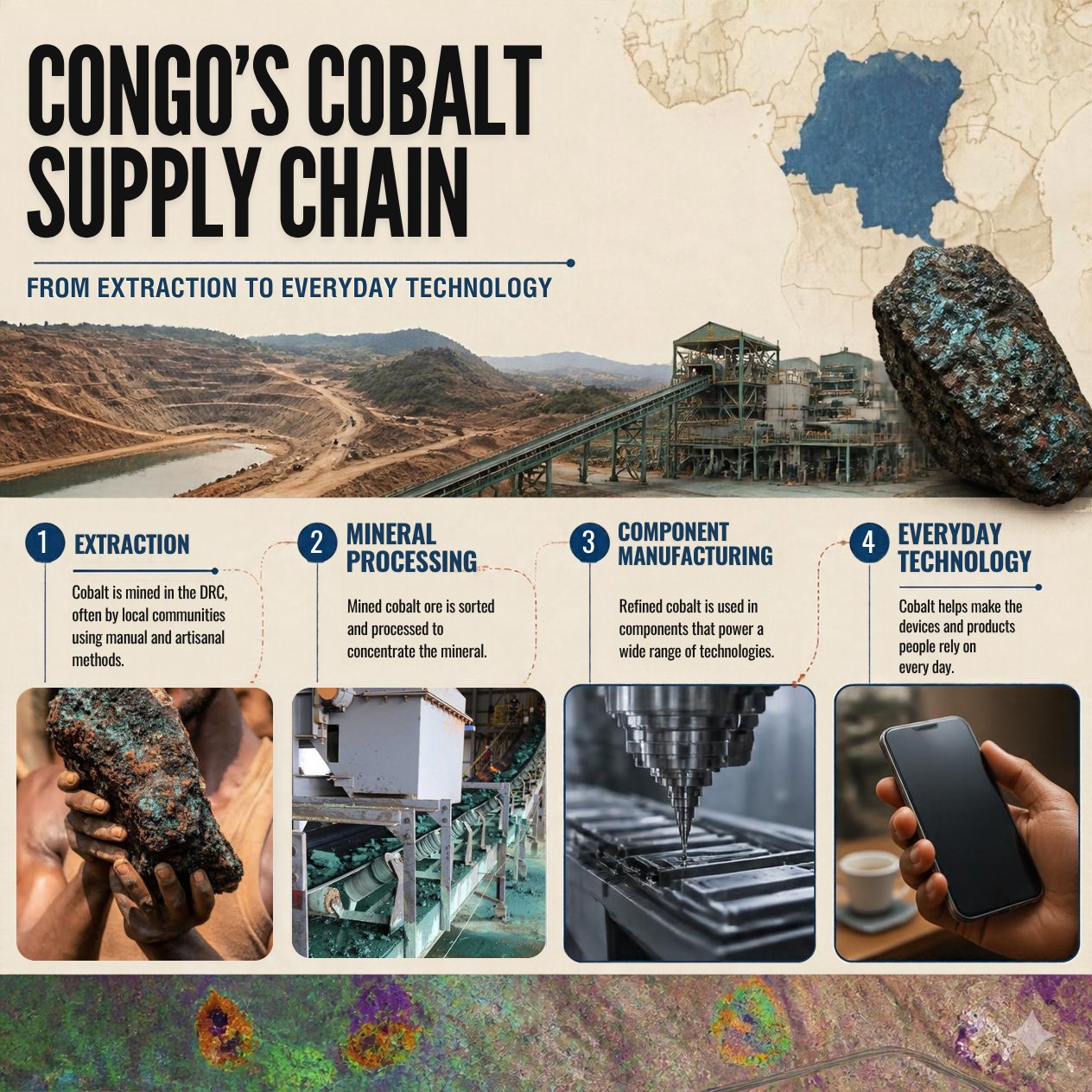
Congo sits at the foundation of the modern economy. Its cobalt, copper, coltan, tantalum, lithium, gold, tin, tungsten, and other minerals power smartphones, computers, gaming systems, electric vehicles, rechargeable batteries, semiconductors, fiber optic networks, aerospace equipment, military technology, renewable energy systems, and the infrastructure behind AI.
Datasets and revisions produce slightly different estimates, but every credible source confirms Congo’s extraordinary dominance of the cobalt market. Analyst Hannah Ritchie reported that Congo produced approximately 68 percent of the world’s cobalt and held about 48 percent of known reserves. Visual Capitalist’s compilation of 2022 production data placed Congo’s share at 73.3 percent nearly 145,000 of 197,791 tonnes. Electric vehicles consumed just over one-third of cobalt used in 2021, while batteries for other consumer products accounted for another 31 percent. The annual percentages move. The underlying reality does not: global industry depends on minerals extracted from Congo. [4][20]
Cobalt is only one link in the chain. Rubaya in eastern Congo supplies a substantial share of the world’s coltan, the ore used to produce tantalum for electronics. Amnesty International documented alleged torture, forced labor, arbitrary detention, pillage, and unlawful killings at rebel controlled mining sites between January 2025 and March 2026. It reported that 18 miners were killed at the Rubaya coltan mine and Lomera gold mine. M23 and Rwandan authorities did not respond to requests for comment on those allegations. [5]
Extraction Without Ownership Is Colonial Power
Foreign powers do not need to own Congo on paper to control what leaves its land. Control travels through mining contracts, debt, purchasing power, processing facilities, military support, private security, border routes, certification programs, and supplier networks designed to obscure who profits and who pays.
Congolese land yields the resources. Congolese workers absorb the danger. Congolese families live with the violence and pollution. Farther down the chain, traders, processors, manufacturers, technology companies, defense contractors, automobile companies, investors, and consumers capture the value.
Congo is not the world’s private mine. Its land, labor, and future belong to the Congolese people.
Follow the Chain. Find the Accountability Gap.
| Stage | What happens | Accountability question |
|---|---|---|
| Mine | Ore is extracted under conditions that may include armed control, unsafe work, forced labor, child labor, or displacement. | Who controls the site, and what can workers report safely? |
| Tag and trade | Minerals are tagged, sold, mixed, moved across borders, or assigned to an approved source. | Does the documented output match what the mine could actually produce? |
| Smelter | Ore from many sources is processed, making physical origin harder to distinguish. | Did the smelter verify origin or rely on an industry program? |
| Manufacturer | Processed minerals become components, batteries, electronics, vehicles, and infrastructure. | Can the company name its mines, traders, smelters, and refiners? |
| Retail and use | A finished product reaches a retailer, employer, institution, investor, or consumer. | What proof supports the ethical-sourcing claim at the point of sale? |
When “Responsible Sourcing” Becomes an Accountability Laundromat
Companies routinely cite audits, supplier codes, and traceability programs as proof that their minerals are responsibly sourced. Those systems require scrutiny because a certification can do more than fail to prevent harm: it can give exploitation the appearance of legitimacy.
Global Witness investigated ITSCI, a mineral traceability program used in the African Great Lakes region. The system is meant to tag tin, tantalum, and tungsten from approved mines so the minerals can be traced through the supply chain. Global Witness found evidence suggesting that minerals connected to armed groups, child labor, forced labor, and unapproved mines entered that tagged supply chain. ITSCI, the International Tin Association, Pact, and several companies disputed various findings and allegations. [6]
The Numbers Expose the System
- In Nzibira, approved mines reportedly produced less than 20 percent of the nearly 83 tonnes of minerals tagged during the first quarter of 2021.
- Global Witness concluded that approximately 80 percent of minerals tagged there came from unapproved mines, including sites connected to armed groups.
- At Lubuhu, approximately 15 times more tin ore was tagged than the two nearby approved mines reportedly produced.
- A consultant cited in the investigation concluded that government officials and local program agents knew about serious problems and participated in a cover-up. The organizations involved disputed allegations of complicity and systemic failure.
Once a bag receives a tag, it can move through exporters, smelters, component manufacturers, and international brands wearing the appearance of legitimacy. Global Witness identified possible links to products sold by companies including Apple, Intel, Samsung, Nokia, Motorola, and Tesla. The named companies offered different responses, including references to sourcing policies and industry programs. [6]
A certificate cannot make a supply chain ethical when the system behind it relies on information supplied by people who profit from moving more minerals. Compliance on paper can coexist with violence on the ground and can help hide it.
No Green or Digital Future Can Be Built on Disposable Lives
Electric vehicles, renewable energy systems, and digital infrastructure can deliver public benefits. Those benefits do not excuse genocide, forced labor, child labor, stolen land, or environmental destruction. A transition that protects wealthy consumers by sacrificing African communities is not justice. It is colonial extraction repackaged in cleaner language and greener branding.
Who Keeps the Violence and Extraction Profitable
The genocide in Congo is sustained by armed force, mineral access, political protection, financial relationships, and public silence. Responsibility is not identical across every institution or country. But difference in degree is not innocence. Beauty Boone names each actor according to the evidence and asks why the systems feeding the violence remain protected, profitable, and difficult to challenge.
Rwanda and M23
The Council on Foreign Relations and Genocide Watch report that Rwanda backs M23. CFR describes Rwanda as M23’s primary external backer and reports an estimated 3,000 to 4,000 Rwandan troops supporting the rebel offensive. M23 captured Goma and Bukavu in 2025 and controls significant territory and mineral resources in eastern Congo. Rwanda has rejected or challenged allegations concerning its role and says armed groups hostile to Rwanda remain a security threat. Those arguments do not erase the documented civilian deaths, displacement, forced recruitment, territorial control, and extraction connected to the conflict. [15][18]
Western power, selective pressure, and mineral access
The United States, United Kingdom, and European Union have condemned violence, supported diplomacy, and in some cases imposed sanctions. Congolese organizers and civil society critics still ask why governments with aid, trade, diplomatic, financial, and security leverage have not used enough of it to stop Rwanda’s support for M23 or protect Congolese sovereignty. The United States has also pursued strategic access to Congolese critical minerals. A 2023 Japan Times commentary by Anjani Trivedi challenged the gap between Washington’s clean energy ambitions and its response to child labor and abuse in Congo’s cobalt supply chain. Peace efforts, industrial policy, and mineral agreements must be examined together because access to resources can shape which lives, borders, and demands receive urgency. [14][18][19]
Israel, the UAE, surveillance, and trade
The Mondoweiss conversation between Friends of the Congo executive director Maurice Carney and professor Eman Abdelhadi brings attention to links among Congo and Palestine through colonial extraction, military and surveillance technology, corporate power, and the treatment of Black and Palestinian life as disposable. It discusses Israeli-linked mining, security, and surveillance relationships, the use of Pegasus spyware against Congolese and Rwandan dissidents, and the UAE’s role in regional mineral and gold trade. These are serious lines of inquiry, and each company, contract, transaction, and government relationship requires specific evidence. Neither Israel nor the UAE is identified in the sources reviewed here as a direct military belligerent inside Congo. That distinction should sharpen the investigation, not close it. [14]
The Congo and Palestine connection
Congo and Palestine have distinct histories, political conditions, and forms of violence. The connection is structural: land and resources are treated as prizes, technology expands surveillance and military power, corporations and governments gain access, and people living under violence are expected to prove their humanity to institutions that benefit from delay. Beauty Boone brings attention to that pattern without collapsing one people’s struggle into another. Solidarity becomes meaningful when it challenges the contracts, weapons, data systems, trade routes, diplomatic protection, and financial incentives that help violence continue. [14]
Demand direct answers
- If governments agree that Rwanda supports M23, why do aid, security cooperation, trade, and mineral agreements continue without consequences strong enough to stop it?
- Which companies, traders, refiners, banks, investors, and governments profit from minerals leaving territory controlled through violence?
- Who audits mineral origin claims when uninterrupted supply benefits the companies and institutions relying on those claims?
- Why are Congolese deaths treated as a humanitarian tragedy while Congolese minerals are pursued as strategic assets?
- Which sanctions, contracts, licenses, and financial relationships connect Western, Israeli, Emirati, Chinese, and regional interests to extraction, security, or surveillance around Congo?
- When a peace agreement protects access to minerals before displaced people can safely return home, whose peace is being negotiated?
- What would accountability require if Congolese sovereignty, local processing, community ownership, reparations, and the right to refuse extraction were the starting point?
Who Takes the Value. Who Absorbs the Violence.
Who captures the value
- Technology and automobile companies gain access to essential minerals.
- Defense and aerospace companies obtain materials required for strategic systems.
- Mining companies, traders, exporters, refiners, and processors earn revenue at each stage.
- Armed groups can tax mines, workers, roads, and border crossings.
- Foreign governments secure resources treated as essential to national security and industrial policy.
- Private security companies obtain lucrative contracts and influence over public functions.
- Consumers receive affordable, powerful, and frequently updated technology.
Who is forced to pay
- Congolese people killed or injured by armed violence.
- Women and girls subjected to rape and sexual violence as weapons of war.
- Families forced from homes and resource rich land.
- Adults and children working under dangerous or coercive conditions.
- Communities living with polluted water, damaged ecosystems, and weakened public services.
- A country denied a fair share of the wealth created from its own resources.
- Future generations living with trauma, instability, and environmental damage.
The price tag is a lie when it hides the lives, land, labor, and future consumed to make the product affordable.
What the Evidence Does and Does Not Prove
Responsible commentary must distinguish documented reporting from inference. Public reporting establishes that Prince’s company has operated in Congo and that its personnel were involved in an ambush. Reporting also connects its work to mineral revenue collection and military support. Public evidence does not establish that every technology company knowingly purchased minerals that funded a specific armed group. Supply chains are layered, mixed, and difficult to trace. That opacity is not a reason to suspend scrutiny; it is central to the accountability problem.
Several governments, companies, and traceability organizations deny or dispute allegations involving smuggling, armed support, or contaminated supply chains. Those denials belong in the record. They must also be tested against mine level production, trade flows, independent investigations, worker testimony, and public disclosure. A denial is a claim not the end of the inquiry.
The Beauty Boone Lens: From Awareness to Power
Personal
Our devices connect us to people we may never see. Individual consumers did not design this system, and shopping choices alone cannot dismantle it. But refusing helplessness matters. We can keep products longer, repair them, buy refurbished equipment, recycle electronics responsibly, question brands, and share credible evidence. Curiosity opens the door. Organized pressure moves power.
Livelihood
Congolese workers create enormous value at the beginning of the technology supply chain while receiving a fraction of what their labor produces. Fair sourcing must include safe conditions, enforceable wages, freedom from forced and child labor, independent worker organizing, protection from retaliation, community consent, Congolese ownership, local processing, and long term public investment.
A clean certificate is meaningless if the worker remains poor, endangered, disposable, and unheard.
Stewardship
Stewardship requires proof, not promises. Companies should identify their mines, traders, smelters, refiners, security contractors, known risks, failed audits, corrective actions, and community investments. They should disclose what happens when harm is found. Real accountability means independent investigation, enforceable consequences, remedy, and reparations.
Village Thinking
Technology links miners, transport workers, factory employees, retailers, office workers, investors, and consumers across borders. Village Thinking turns those relationships into collective leverage. Employees can challenge procurement. Investors can challenge boards. Retailers can challenge vendors. Consumers can challenge brands. Organizers can connect those demands so companies cannot isolate, delay, or quietly dismiss them.
Questions Companies Should Not Be Allowed to Evade
- Can the company trace its cobalt, coltan, tantalum, gold, tin, tungsten, copper, and lithium to the mine?
- Could Congolese minerals enter through Rwanda or another country and lose their documented origin?
- Who verifies the company’s claims, who pays the verifier, and what happens when the evidence contradicts the certification?
- How many suppliers failed audits, and what happened next?
- Would the company halt production or pull a profitable product if the evidence showed that human lives were at risk?
- How much of the product’s value returns to Congolese workers and communities, and who controls that money?
- Which executive is accountable when due diligence fails, and what consequence follows?
- Whose lives, land, and wealth is a private military contractor protecting, and whose freedom does that power restrict?
- Does the business model require Congolese labor, land, and minerals to remain cheap, hidden, and easy to control?
How to Investigate a Company and Press for Answers
You do not need to become a mining expert before demanding better answers. Start with one company, one device, or one workplace purchasing decision. Follow the evidence as far as it goes. Record what the company discloses, what it avoids, and what it cannot prove.
A 15-Minute Corporate Accountability Check
- Search the company name with “conflict minerals report PDF” or “Form SD.”
- Open the newest report and confirm the reporting year. An old policy page is not current evidence.
- Search within the document for: Congo, DRC, Rwanda, ITSCI, RMI, smelter, refinery, audit, child labor, forced labor, remediation, suspension, and termination.
- Look for a list of specific smelters and refiners. General promises are weaker than named facilities.
- Check whether the company identified actual risks or said it could not determine the origin of its minerals.
- Look for consequences. Did it suspend a supplier, compensate workers, publish corrective action, or provide remedy?
- Compare the company’s statement with independent reporting from Congolese groups, the United Nations, Amnesty International, and Global Witness.
- Save the report and date. Compare it with the next filing to see whether the company changed anything.
Red Flags That Signal Evasion
- The company repeats its values but provides no mine, trader, smelter, or refinery names.
- It treats membership in an industry program as proof that the supply chain is clean.
- It says suppliers must follow a code without explaining how violations are detected.
- It celebrates the number of audits while hiding failures, corrective actions, and consequences.
- It avoids Rwanda even though smuggling routes are part of the documented risk.
- It focuses on protecting the brand from risk while saying nothing about remedy for the people harmed.
- It uses “zero tolerance” language while continuing to purchase from a supplier under investigation.
- It presents recycling or cobalt reduction as a complete answer while ignoring coltan, gold, tin, tungsten, copper, and other minerals.
A Message That Demands Evidence
I am reviewing your current conflict minerals and responsible sourcing disclosures. Please identify the mines, traders, smelters, and refiners connected to the cobalt, coltan, tantalum, tin, tungsten, and gold in your products. Explain whether your due diligence relies on ITSCI or the Responsible Minerals Initiative, how you independently verify those systems, how many suppliers failed your latest review, what consequences followed, and what remedy was provided when harm was found. Please also disclose how much of the value generated from these minerals is invested in Congolese workers and communities. Send source documents, audit findings, and corrective action records, not a general policy statement.
Turn Concern Into Leverage
Use your power as a consumer
- Keep functioning devices longer and resist upgrade cycles designed around status rather than need.
- Choose repairable and refurbished products when they meet your needs.
- Use company reports and customer service channels to ask documented questions with other consumers. Repeated public demands are harder to dismiss.
Use your power at work
- Ask procurement teams how devices, batteries, vehicles, and technology vendors are evaluated.
- Request mineral sourcing criteria in vendor scorecards and requests for proposals.
- Ask how human rights risks are escalated. Use collective channels, employee groups, unions, or written policies when individual retaliation is possible.
Use your power as a buyer or business owner
- Request current conflict minerals reports from technology and electronics vendors.
- Add repair, refurbishment, trade-in, and responsible recycling options.
- Train buyers to evaluate evidence beyond certifications, then publish what you learn, including unresolved gaps.
Use your power as an investor
- Review portfolio exposure to mining, technology, automobile, defense, battery, and electronics companies.
- Ask investment managers how conflict mineral risk affects proxy voting and engagement.
- Support shareholder resolutions requesting mine level disclosure, human rights due diligence, and remedy.
Use your power as a voter and community member
- Ask elected officials whether they support strong enforcement of conflict minerals disclosure requirements.
- Oppose mineral access and private security agreements negotiated without public transparency.
- Demand enforceable labor and human rights standards while supporting Congolese sovereignty, ownership, local processing, community consent, and reparations.
Learn Support and Act
Begin with Congolese led voices and primary documents. Before donating, purchasing, or sharing, review each organization’s current work, leadership, financial information, and security guidance.
Education, advocacy, and global organizing developed in partnership with Congolese people.
Visit resource →Congolese-led care for survivors of sexual violence, including medical treatment, psychosocial support, legal assistance, and economic empowerment.
Visit resource →Evidence and recommendations concerning the alleged laundering of conflict minerals through a major traceability system.
Visit resource →Human rights reporting and action resources concerning armed groups, mining, displacement, and state responsibility.
Visit resource →Explains which public companies may file Form SD and a Conflict Minerals Report.
Visit resource →Search public company filings. Enter a company name, then look for Form SD and related exhibits.
Visit resource →Due diligence guidance and tools used by governments and companies. Use them as a benchmark, then examine implementation.
Visit resource →What to do this week
1. Choose one device you use every day.
2. Find the manufacturer’s latest conflict-minerals report.
3. Search it using the terms in the fifteen minute check.
4. Write down one answer you found and one answer the company avoided.
5. Send the company a direct question and share the source with one other person.
6. Follow at least one Congolese led organization and support its work if you have the resources.
Our lives depend on technology. The technology depends on minerals. The minerals come from land where people are being killed, displaced, exploited, and denied the wealth beneath their own feet. That chain connects us.
The question is whether we will continue accepting corporate assurances or demand evidence, Congolese ownership, accountability, reparations, and an end to the genocide.
What are we willing to change once we can no longer claim that we did not know?
Editorial distinction
Reported facts and allegations are attributed to their sources. Beauty Boone’s analysis concerns the political and moral meaning of those facts, the structure of the supply chain, and the responsibilities of institutions and consumers. Allegations disputed by the relevant parties are identified as disputed. Readers should use the linked sources, review company responses, and continue following Congolese journalists and organizations as conditions change.
Sources and Further Reading
- 1. Erik Prince’s forces suffer battlefield loss in Congo, former UFC fighter among wounded. Reuters, October 9, 2026. Open source →
- 2. Trump supporter Prince reaches deal with Congo to help secure mineral wealth. Reuters, April 17, 2025. Open source →
- 3. Trump ally Prince sent men, drones to help Congo’s army secure strategic town. Reuters, February 10, 2026. Open source →
- 4. Is cobalt the blood diamond of electric cars What can be done about it. Hannah Ritchie, By the Numbers, July 28, 2023. Open source →
- 5. Amnesty accuses M23 of abuses amounting to war crimes at Congo mines. Associated Press, September 21, 2026. Open source →
- 6. The ITSCI laundromat. Global Witness, April 26, 2022, updated May 30, 2022. Open source →
- 7. Special Report Conflict Minerals in the Democratic Republic of the Congo. Genocide Watch, June 9, 2025. Open source →
- 8. Conflict Minerals Disclosure. U.S. Securities and Exchange Commission, accessed October 2026. Open source →
- 9. Responsible mineral supply chains. Organisation for Economic Co-operation and Development, accessed October 2026. Open source →
- 10. Global brands likely using mineral that funds rebels accused of atrocities in DRC investigation finds. The Guardian reporting on Global Witness, June 10, 2026. Open source →
- 11. Hundreds killed in Haiti drone strikes including 60 civilians Human Rights Watch says. Reuters, March 10, 2026. Open source →
- 12. US officials see closer ties with Trump ally Prince’s security firm in Haiti military adviser says. Reuters, July 21, 2026, updated July 22, 2026. Open source →
- 13. The ground shook Drone attacks help Haitian government wrest control of capital from criminal gangs. The Guardian, July 2, 2025. Open source →
- 14. Understanding the connections between the Congo and Palestine genocides. Mondoweiss, August 3, 2024. Open source →
- 15. DR Congo Genocide Emergency 2025. Genocide Watch, September 30, 2025. Open source →
- 16. BBC reporting on Rwanda, M23, and the war in eastern Congo. BBC News, accessed October 2026. Open source →
- 17. DR Congo: UN Report Exposes Grave Crimes. Human Rights Watch, October 1, 2010. Open source →
- 18. Conflict in the Democratic Republic of Congo. Council on Foreign Relations Global Conflict Tracker, accessed October 2026. Open source →
- 19. ‘Blood batteries’ drive America’s frantic EV ambitions. Anjani Trivedi, The Japan Times and Bloomberg Opinion, February 3, 2023. Open source →
- 20. Ranked: The World’s Top Cobalt Producing Countries. Bruno Venditti, Elements by Visual Capitalist, July 24, 2023. Open source →
More from The Beauty Boone Brief and recent commentary: